Loved by RIAs, Independents, and Wirehouses nationwide
The Real Problem
Most advisors have the pieces. Almost none have a filter.
Referrals one way. Seminars another. Direct mail, a third. Cold calling whenever there’s time left.
Each one starts with real energy. Six months later, most are quietly dropped. Not because they didn’t work, but because there are only so many hours in a day.
That’s the part no one helps with. Not what to do. What to do next.
Knowing what to do and actually doing it are two different things.
We've spent 50 years on the second one.
Practices don’t stall on ideas. They stall in the week it was supposed to happen.
So we test a process in real offices until it works every time. Then a coach makes sure you run it.
$25M to $550M in AUM. Same headcount. Matt Hicken grew his own team over about 14 years running this system from your side of the desk, before he ever coached anyone through it.
118 best practices, each proven in real advisor offices
One project at a time, with someone holding you to it
What's working today, not what worked a decade ago
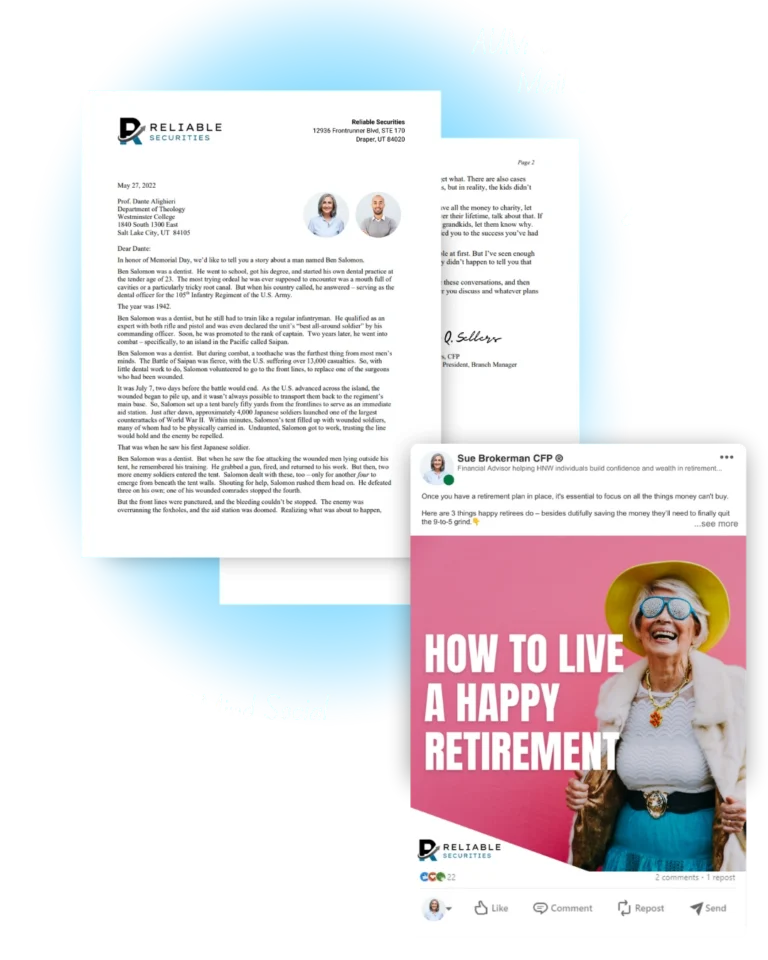
You don't have to be a writer to stay in front of people.
Say more, without starting from scratch.
Some of the best advisors we work with will tell you flat out that communicating was never their strength. So staying visible becomes the thing that never gets done. It shouldn’t take a blank page and an hour you don’t have.
This is the one part we don’t hold you to. We just do it for you.
Compliance-approved letters and emails, ready when you need them
Volatility content ready within 24 to 48 hours of major news
More time with clients, less time staring at a cursor
This is what it looks like when it finally gets done.
"Bill, we started at $60 million in assets, now we’re at $660 million. We didn’t just double... We 10X’d!"
Neil M.
Financial Advisor, New Jersey, USA
faq
Before you book
Do I need to have my act together first?
No. And this is the one we most want to put to rest.
You don’t have to get all of the best practices in place to enjoy the benefits of the best practices.
Advisors regularly open the first call by telling us they’re not sure we can even help them, or that they should probably get organized first so they don’t waste our time. Almost none of them were “ready.” It didn’t matter. No reports, no numbers, no pitch. Just an honest conversation about what’s working and what’s stalled.
Is this going to become one more thing on my plate?
That’s the exact thing we’re trying to solve, so no.
You already have more to work on than time to work on it. Handing you a longer list would be pointless. Your strategist picks the one thing that moves you fastest, and you start there. One project. Not twelve.
And your coach stays on it until that project is actually done — not until the plan is written.
Is BGM a fit for a practice like mine?
We’ve worked with advisors at nearly every stage, from those building a first book to teams past $1B. There’s no hard AUM cutoff.
The advisors who get the most from this have one thing in common: they’re ready to run a proven system and stay with it, rather than hunting for one more tactic. Part of the first call is figuring out, honestly, whether that’s you. Sometimes the answer is no, and we’ll tell you.
I'm close to retiring. Is it worth starting now?
Often, yes — though for a different reason than you’d expect.
If you’re planning to sell or transition your book, what it’s worth depends heavily on how organized it is and whether it’s still growing. A practice that runs on a system transfers better than one that lives in your head.
And if you’re not going anywhere yet, that’s fine too. Plenty of the advisors we work with have no intention of retiring. They just want the next few years to feel different from the last few.
Five years from now, this is either solved or it isn't.
The advisors who fix it are the ones who stopped trying to fix it alone.
What you’ve done the last five years is not going to get you where you want to go in the next five. You already know that: it’s why you’re on this page.
One call. Fifteen minutes. No cost.
Find out which pieces of the system you’re already running, which ones are missing, and what to do first.