
The wealthiest families in America are sitting ducks.
Not at work — at work, they’re surrounded by enterprise-grade security teams, multi-factor authentication, threat monitoring, and IT departments with seven-figure budgets. At home, with their families, on their personal devices and home networks, they have almost nothing. And the hackers figured this out about five years ago.
Since 2020, sophisticated cybercriminals have shifted their focus away from corporations and directly onto wealthy individuals and their families. These aren’t the obvious phishing scams. These are year-long surveillance operations — what BlackCloak calls “Ocean’s 11 hackers” — that pick a single target, study them for months, embed themselves in email accounts, and wait for the right moment to pull off the heist.
You’ve probably heard about an incident or two. Maybe a client called you in a panic. Maybe you watched a peer lose a multi-million-dollar relationship over a wire fraud cleanup that didn’t go well.
What you might not know is just how big the opportunity is on the other side of this.
45% of high net worth individuals now say cybersecurity is what keeps them up at night — ranking it above pandemics and above their own health. 62% want a single trusted advisor to coordinate everything for them, including this. And almost no advisor is offering it.
That’s what we covered in this webinar.
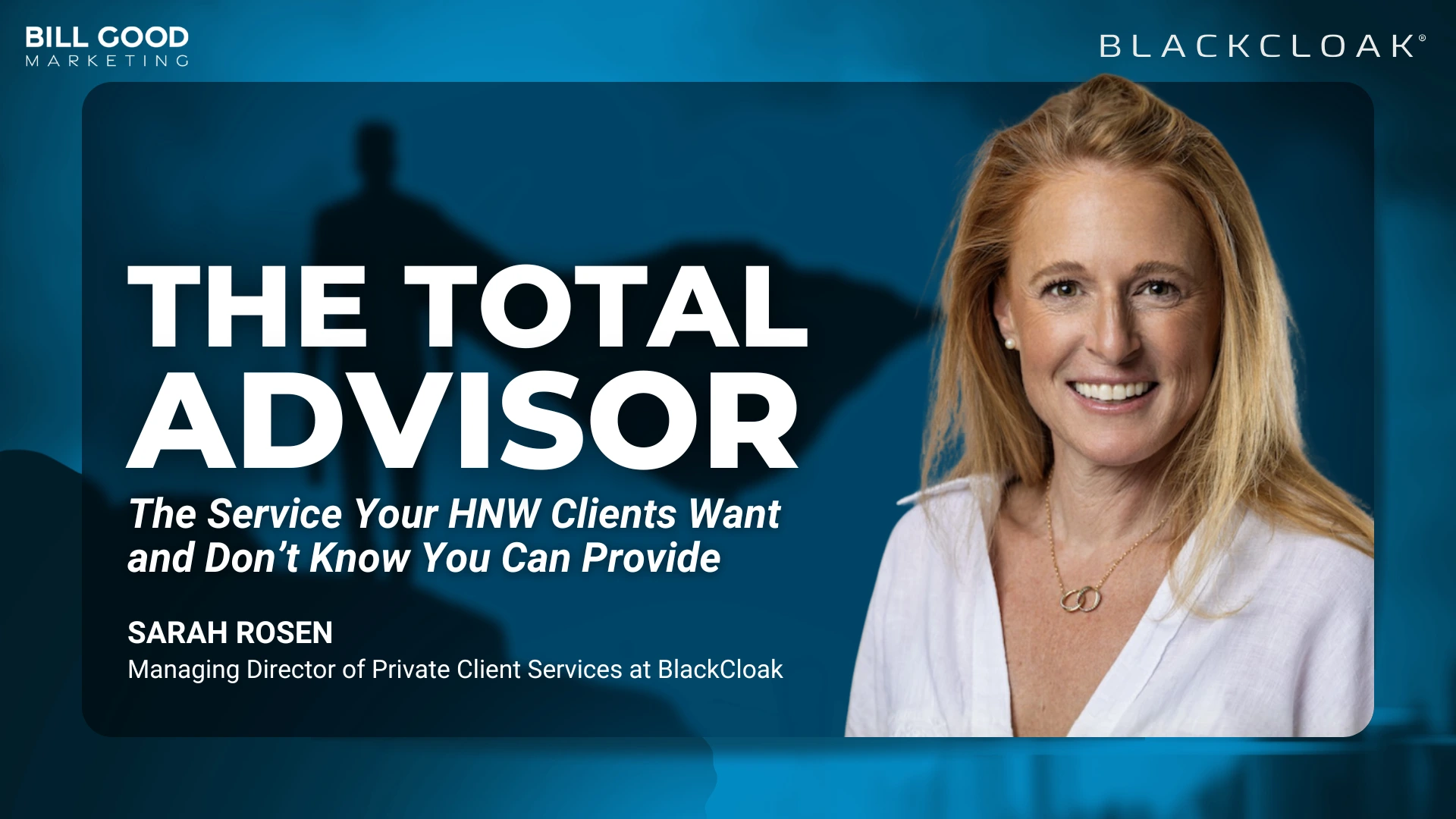
Matt Hicken, Senior VP of Consulting at Bill Good Marketing, sat down with Sarah Rosen, Managing Director of Client Services at BlackCloak — the firm protecting high net worth and high-profile individuals across 49 countries — to talk through what’s actually happening in cybersecurity for HNW and UHNW families, and what financial advisors need to be doing about it right now.
This isn’t a sales pitch dressed up as a webinar. It’s a working conversation between two people who talk to wealthy families and the advisors who serve them every single day.
Here's what's covered:
- The real threat landscape — who’s being targeted, why the $2M–$10M client segment is the most underserved and most vulnerable group, and why the “Apple Halo” is leaving your clients exposed
- How modern cyber heists actually work, from data broker exposure and dark web breaches to router vulnerabilities, IoT devices, and SIM-swap attacks on phones
- What real protection looks like — data broker removal, device hardening, business-grade anti-malware, home network monitoring, and 24/7 concierge response
- The 4 account types every client must secure with strong passwords (email, finance, social media, healthcare) and why most clients only protect one of them
- How to handle a client mid-breach — including romance scams, wire fraud, and the case where the “FBI” on the phone was also the hacker
- The 3-step framework for adding cybersecurity to your practice without becoming an IT firm: education, consistency, and community outreach
The advisors who address cybersecurity now will own the comprehensive-planning conversation with HNW and UHNW families for the next decade. The ones who don’t will watch those clients gradually walk to advisors who do — not because cybersecurity is more important than investment management, but because it’s the gap that makes a client feel genuinely taken care of versus just managed.
This is what “comprehensive planning” actually means in 2026. Everyone says the words. Almost no one is doing the work.
BGM’s job is to help you do the work. To bring you the right partners, the right systems, and the right conversations so you can be the single trusted advisor your clients want — without having to become a cybersecurity expert yourself.
Because you became an advisor to build relationships and grow wealth.
We want to keep it that way.
Watch the full replay below. Stick around to the end for the QR code to download BlackCloak’s Personal Cybersecurity Assessment — a 20-question evaluation you can hand to a client this week.

Sarah Rosen
Managing Director
BlackCloak

Matt Hicken
Sr. VP of Consulting
Bill Good Marketing